

Puppy Potty Training: The Complete Guide for New Dog Owners (2026)
You brought a puppy home and now you’re cleaning the carpet again at midnight. Here’s everything you actually need to know — step by step, clearly explained, and backed by published veterinary and behavioural sources.

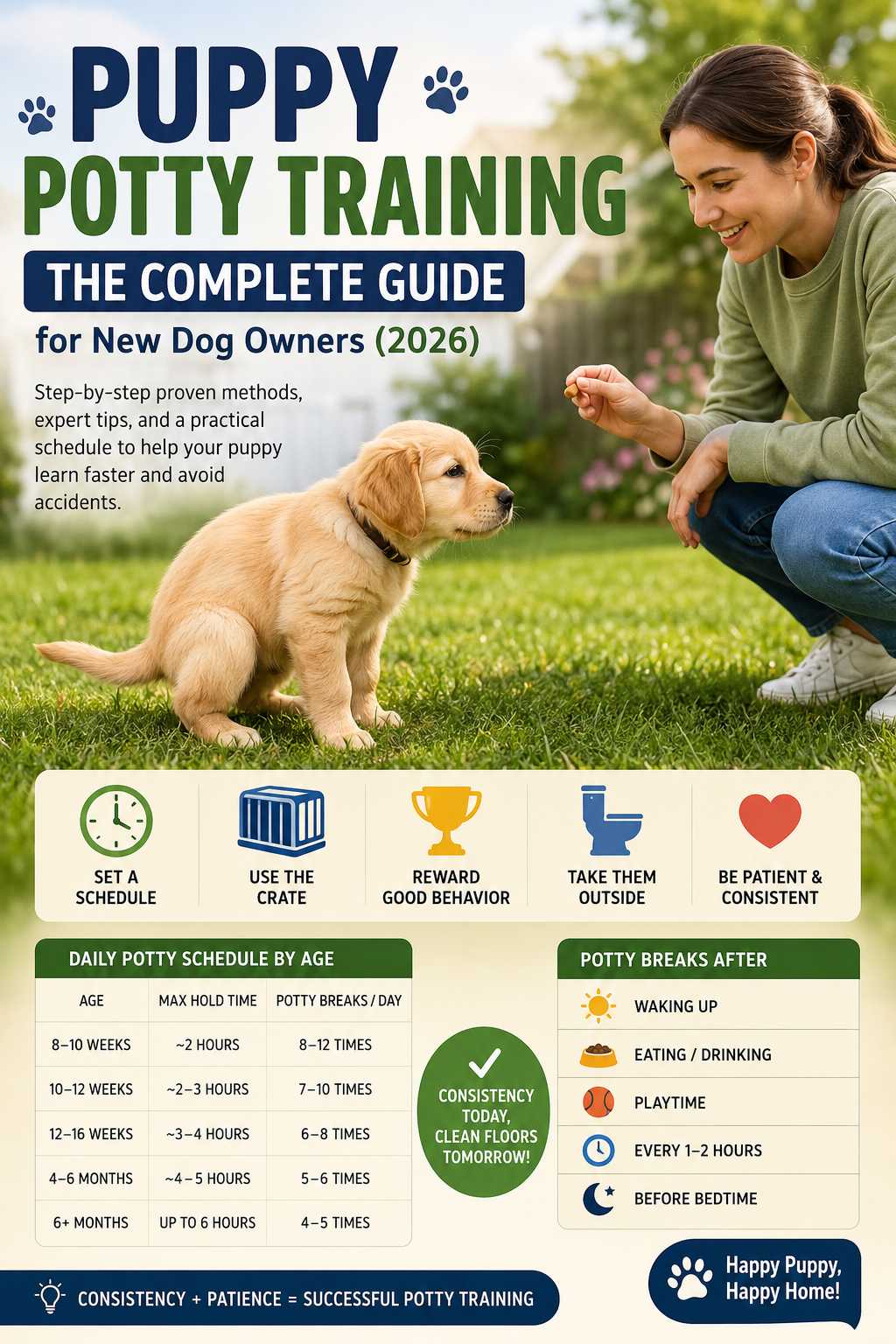
Puppy potty training works by taking your puppy outside at predictable moments — after waking, after eating, after play, and every one to two hours — then rewarding them immediately when they go in the right spot. Most puppies reach reliable house-training between four and six months of age. Consistency matters more than any product or trick.
1. Understanding Why Puppy Potty Training Takes Time
Before frustration sets in, it helps to understand what is actually happening inside a young puppy’s body. A puppy does not have full control over its bladder and bowel muscles until somewhere between 12 and 16 weeks of age — sometimes later, depending on the individual dog and breed.
A widely used benchmark, cited in guidance from the American Kennel Club, is that puppies can hold their bladder for roughly one hour per month of age. A two-month-old puppy can manage about two hours; a four-month-old, about four hours; and so on, up to around six months when the timeline starts to plateau. Note: this is a guideline, not a biological guarantee. Smaller breeds, individual variation, and stress can all affect the actual window.
What “accidents” actually are
When a puppy eliminates indoors, it is almost always because they needed to go before you offered the opportunity — not because they are being defiant or spiteful. Dogs do not have the cognitive framework to plan revenge. Accidents are a schedule problem, not a character problem.
Breed and size differences
Smaller breeds (chihuahuas, toy poodles, dachshunds) tend to have smaller bladders and faster metabolisms, which generally means they need more frequent outdoor trips and often take longer to reach full reliability. This is worth factoring into your expectations, particularly if you are comparing notes with someone who owns a Labrador.
What full house-training actually looks like
“Fully potty trained” means your dog can be trusted indoors unsupervised without accidents — not just that they go outside when you take them. That level of reliability typically comes after months of consistent practice, not weeks. Being patient with the process is not optional; it is the process.
2. Building a Puppy Potty Training Schedule
A schedule is the single most powerful tool in house-training. The goal is to make the desired behaviour easy by giving your puppy constant, predictable access to the right spot, then rewarding success immediately.

The five non-negotiable potty moments
Regardless of age or breed, every puppy should be taken outside at these five moments, without exception:
| Moment | Why it matters | How soon after |
|---|---|---|
| Waking up (morning or nap) | Bladder releases immediately on waking | Within 5 minutes |
| After eating or drinking | Digestion triggers the gastrocolic reflex | Within 10–20 minutes |
| After active play | Excitement and movement stimulate elimination | Within 5–10 minutes |
| Timed breaks throughout the day | Bladder fills on a schedule — yours prevents accidents | Every 1–2 hours for young puppies |
| Before bedtime | A final empty bladder extends overnight sleep | Last thing before crating |
Age-by-age rough schedule
The following is a general framework only. Adjust based on your puppy’s actual signals and consult your vet if you notice your puppy eliminates far more frequently than expected, as this can sometimes indicate a urinary issue.
| Puppy Age | Approx. Max Hold Time | Daytime Potty Trips |
|---|---|---|
| 8–10 weeks | ~2 hours (awake); may need 1–2 night trips | 8–12 trips |
| 10–12 weeks | ~2–3 hours awake | 7–10 trips |
| 12–16 weeks | ~3–4 hours awake | 6–8 trips |
| 4–6 months | ~4–5 hours | 5–6 trips |
| 6+ months | Approaching adult range (up to 6 hours) | 4–5 trips |
How to reward successfully
Timing matters enormously. The reward — a treat, enthusiastic praise, or brief play — needs to happen within a few seconds of the puppy finishing, not when you get back inside. That connection between the action and the reward is what builds the behaviour. Going outdoors then rewarding indoors teaches the puppy that coming inside earned the treat.
Choose a consistent cue word (“outside,” “bathroom,” “quick” — whatever you will remember to use consistently) and say it every single time you take the puppy to their spot. Over time, this cue can prompt the puppy to go on request, which is genuinely useful.
What to do after an indoor accident
Clean it thoroughly with an enzymatic cleaner — regular household cleaners often leave odour traces that attract the puppy back to the same spot. Do not scold the puppy, especially after the fact. Research and veterinary guidance consistently indicate that punishing after-the-fact achieves nothing useful, because the puppy cannot connect a reprimand to something that happened minutes earlier.
3. Crate Training: The Den Principle
The crate is one of the most misunderstood tools in puppy training. Used correctly, it is not a cage or a punishment — it is a safe, calm space that also helps with potty training. Most dogs naturally prefer a snug resting area, and a properly sized crate works with that instinct.
Why crates help with potty training
Dogs generally avoid soiling where they sleep. A crate that is just large enough for the puppy to stand, turn around, and lie down exploits this instinct — the puppy will try to hold it rather than soil their sleeping space. A crate that is too large defeats this purpose because the puppy can use one end as a toilet and sleep at the other.
If you have a large crate intended for your adult dog, many have a divider panel that lets you partition off a smaller section for the puppy’s early weeks.
How to introduce the crate
Never put a puppy in a crate for the first time and leave. Introduce it gradually over several days. Start by placing treats and toys near the open crate, then inside it, then close the door for a minute while you stay nearby. Gradually extend the time. The goal is for the puppy to walk in voluntarily. A crate a puppy was never forced into is one a puppy will actually use willingly.
How long is too long in a crate?
The age-based hold-time guideline applies here. Do not leave a young puppy crated for longer than they can physically hold their bladder. Most welfare guidance and training professionals consider four hours a reasonable daytime maximum for a young puppy, and overnight stints should be broken up with a middle-of-the-night potty trip for puppies under around 12 to 16 weeks.
There is debate among trainers about crate time duration and frequency. Some argue that crates should be used sparingly and primarily for sleep, while others use them more throughout the day for management. What is widely agreed is that a crate should never be used as punishment, and extended confinement beyond the puppy’s physical capacity is not appropriate.
4. How to Stop Puppy Biting and Mouthing
If your puppy is biting you, your clothes, your furniture, and apparently everything else in your home — you are not alone, and your puppy is not broken. Mouthing is one of the most normal puppy behaviours there is. Puppies explore the world primarily with their mouths. It is how they play, learn, and communicate.
Bite inhibition: the concept that changes everything
Before puppies leave their litters, they begin learning what is called bite inhibition — the ability to control the pressure of their bite. When a puppy bites a sibling too hard, the sibling yelps and stops playing. The puppy learns that hard biting ends the fun. This is one of the reasons the generally recommended age to bring a puppy home is around 8 weeks rather than earlier, as noted by the American Kennel Club.
Your job as the puppy’s new household is to continue this education. The goal is not to eliminate all mouthing overnight (that is unrealistic in young puppies) but to teach them that human skin is off-limits and that there are appropriate things to bite instead.
The yelp-and-pause method
When your puppy bites your hand or clothing, let out a calm but audible “ouch” or “ow” and immediately withdraw your attention for 15 to 30 seconds — stand up, turn away, or briefly leave the room. Then return and redirect to a chew toy. Repeat consistently. This mirrors what a littermate would do.
Some trainers find the yelp method actually excites certain puppies further. If that happens with your dog, try a firm, flat-toned “too bad” and immediate withdrawal of attention rather than a loud sound. There is not one universal approach that works for every dog — this is an area where trainer opinions differ, and a certified trainer can help you tailor the approach.
What not to do
Physical corrections — tapping the nose, holding the mouth closed, scruffing — are not supported by current behavioural evidence as effective bite inhibition strategies, and the American Veterinary Society of Animal Behavior (AVSAB) recommends against the use of punishment in training, citing potential negative effects on fear, learning, and aggression. Physical corrections can also damage the trust between puppy and owner at a stage when that relationship is still forming.
Normal biting vs. something to take seriously
Normal puppy mouthing is usually playful, the puppy is loose and wiggly, and the biting stops when attention is withdrawn. Biting that draws blood regularly, accompanies stiff body posture, growling, resource guarding, or occurs when a puppy is cornered or handled gently is a different matter. If you are unsure, consult a certified trainer or your vet rather than waiting.
6. Basic Commands Every Puppy Should Learn First
Puppies can begin learning basic cues from the moment they arrive home. Short, frequent sessions work far better than long ones: two to five minutes, repeated three to five times a day, is far more productive for a young puppy than a single 20-minute session. End every session on a successful note.
The five starter cues
These five give you the foundation for a safe, well-mannered dog, and each builds on skills the puppy already has:
| Cue | Why it matters | Simple starting point |
|---|---|---|
| Sit | Gateway to most other training; gives the puppy a default polite behaviour | Hold a treat at puppy’s nose, move it back over their head — bottom goes down |
| Come (recall) | The most important safety cue a dog can learn | Crouch down, call the puppy’s name cheerfully; reward extravagantly every single time |
| Stay | Teaches impulse control and the value of waiting | Ask for a sit; pause one second; reward before the puppy moves; gradually increase duration |
| Leave it | Safety cue for dropped food, hazards on walks, or anything you do not want eaten | Hold a treat in your fist; wait for puppy to stop nosing at it; when they pull back, reward with a different treat |
| Name recognition | Foundational — a dog that looks at you when you say their name is easier to manage in every situation | Say the puppy’s name once; the instant they look at you, reward |
Positive reinforcement: the evidence-based method
The AVSAB’s position statement on humane dog training states that evidence supports the use of reward-based methods for all canine training. This does not mean a puppy should never hear “no” — it means that actively rewarding the behaviour you want produces faster, more reliable, and more lasting results than attempting to punish the behaviour you do not want.
When to get professional help
A good puppy class is genuinely worth the investment — not just for training, but for supervised socialisation and the opportunity to get real-time guidance from a qualified trainer. When choosing a trainer, look for credentials from a recognised professional body in your country:
| Country | Look for | Where to search |
|---|---|---|
| USA | CPDT-KA or CPDT-KSA (via CCPDT) | ccpdt.org |
| UK | IMDT accredited trainer or ABTC-registered member | imdt.uk.com |
| Canada | CAPDT member or CPDT-KA certified | capdt.ca |
| Australia | PPGA member or APDT Australia member | ppgaustralia.net.au |
| New Zealand | Trainer referred by your vet or a PPGA-recognised professional | Ask your vet for a referral; PPGA lists NZ-based members |
Publishing note: Verify the current status and URLs of these organisations before publishing, as certifying bodies update their websites and membership criteria periodically. The CCPDT, IMDT, CAPDT, and PPGA details above were checked as of June 2026.
7. What Recent Research Shows
The science of dog training has developed considerably over the past two decades, and the picture that emerges is fairly consistent: methods that rely on reward, positive associations, and clear communication produce better long-term outcomes than methods that rely on punishment or the suppression of behaviour through fear or pain.
On training methods and welfare
A body of peer-reviewed research has examined the relationship between training methods and dog welfare. The AVSAB’s 2021 position statement on humane dog training reviewed multiple studies and concluded that evidence supports reward-based methods for all canine training. The statement notes that the use of aversive tools and methods (such as shock, prong, or choke collars) as a first-line approach is not supported by the research and carries risks of increased fear and anxiety.
It is worth noting, however, that individual studies have had varying methodologies and sample sizes, and the training research field continues to evolve. Where evidence is mixed, we say so rather than presenting one position as universally settled.
On socialisation and lifelong behaviour
Research on canine development consistently highlights the critical socialisation window. The core finding — that dogs with limited early socialisation are at greater risk of fear, anxiety, and reactive behaviour as adults — is well-supported. The AVSAB has also published a position statement on puppy socialisation, addressing how vaccination protocols affect early socialisation and recommending that socialisation efforts begin as early as safely possible.
On punishment and learning
The AVSAB’s statement on the use of punishment concludes that punishment should not be a first-line approach for behaviour problems, due to risks including inhibition of learning and increased fear-related behaviour. While some trainers continue to use balanced (reward-and-correction) approaches, the weight of current veterinary behavioural guidance points toward positive reinforcement as the foundation for puppy training — particularly during the early developmental period.
8. Common New Dog Owner Mistakes
These are the patterns that appear most often when puppy training stalls or goes sideways. None of them make you a bad owner — they are simply easy to fall into, especially when you are sleep-deprived and mildly desperate.
This one is surprisingly common because it was taught to a lot of people by well-meaning relatives. The idea is that showing the puppy what they did wrong teaches them not to do it again. It does not work that way. A puppy cannot connect a reprimand — especially after the fact — to an event that happened minutes ago.
Beyond being ineffective, physical correction can make the puppy anxious about eliminating in your presence at all, which leads to hiding accidents in corners rather than fewer accidents overall.
Better approach →Clean thoroughly with an enzymatic cleaner to remove odour traces. Take the information and adjust your schedule. Nothing else is needed.
An inconsistent schedule is the single biggest reason house-training drags on. Puppies learn through repetition and pattern. Every time a puppy goes outside at the right moment and gets rewarded, that pattern strengthens. Every gap in the schedule is an opportunity for an accident and a weakened learning signal.
Better approach →Set phone alarms for potty break times if that is what it takes. Treat the schedule like a feeding schedule — it does not get skipped. Two or three weeks of rigorous consistency usually produces a noticeable jump in reliability.
Allowing a young puppy to roam the entire house unsupervised is essentially giving them the opportunity to practise going to the toilet in every room. It also means accidents happen in places you do not even notice, leaving odour traces that attract the puppy back.
Better approach →Use a crate when you cannot watch the puppy directly, and use a playpen or baby gates to limit access to one or two rooms. Expand access gradually as reliability improves — typically over weeks and months, not days.
This is the mistake with the longest-lasting consequences. Owners who wait until a puppy’s vaccination course is fully complete before allowing any social exposure often miss the critical window. A dog that reaches 16 weeks having met only a handful of people and environments is at significantly higher risk of developing fear or anxiety as an adult.
Better approach →Talk to your vet about safe, lower-risk socialisation strategies before full vaccination — these exist. Attend puppy classes at facilities that require vaccination proof and use clean facilities. The risk calculation is a conversation between you and your vet, not an all-or-nothing decision.
New owners sometimes become genuinely frightened by their puppy’s biting and conclude there is something wrong with the dog. In the vast majority of cases, normal puppy mouthing is not aggression — it is play, exploration, and communication. Treating it as aggression can lead to responses that backfire (physical corrections, isolation) or unnecessary anxiety.
Better approach →Learn to read body language. A puppy that is biting playfully is typically loose, bouncy, and will stop or redirect when given the opportunity. If you genuinely cannot tell, consult a certified trainer rather than defaulting to alarm.
“We’ll start training when they’re a few months older” is one of the most common things new owners say — and by then, the habits they intended to prevent are already formed. Puppies start learning the moment they arrive. If you are not intentionally teaching them, they are teaching themselves.
Better approach →Start the day the puppy arrives home. The first cue to teach — sit — takes about five minutes to introduce and immediately gives the puppy a way to ask for things politely. Starting early is not stressful for puppies; it is enriching.
9. Final Evidence-Based Recommendations
The following recommendations are drawn from published veterinary and behavioural sources and reflect the consensus of recognised professional organisations. They are framed as commonly recommended guidance, not as personal clinical advice. For anything specific to your puppy’s health or behaviour, consult your vet or a certified trainer.
- Start a schedule on day one. A predictable routine is the foundation of potty training. Use the one-hour-per-month-of-age guideline as your starting point and adjust based on what you observe.
- Reward the right behaviour immediately. The treat, praise, or play should happen within a few seconds of successful outdoor elimination — not when you get back inside. Timing is the mechanism of learning.
- Use the crate as a management tool, not a punishment. Introduce it gradually, use the right size, and never leave a puppy crated beyond their physical capacity to hold their bladder.
- Begin socialisation as safely as possible, and start early. Speak with your vet about low-risk exposure strategies during the vaccination period. The socialization window is time-limited; the consequences of missing it are not.
- Use positive reinforcement as your primary training method. Current evidence from organisations including the AVSAB supports reward-based training as effective and welfare-appropriate for puppies.
- Redirect biting consistently to appropriate chew toys. Teach bite inhibition through calm withdrawal of attention, not physical correction. Expect it to take weeks of consistent practice before significant improvement.
- Manage the environment to prevent rehearsal of unwanted behaviours. A puppy that cannot access the sofa will not develop the habit of getting on the sofa. Management reduces the need for correction.
- Find a qualified trainer if you are struggling. Early intervention is far easier than trying to modify established behaviour later. Use the certification guidance in Section 6 to find a science-based trainer in your country.
- Rule out medical causes for persistent accidents. If a puppy that was making progress suddenly starts having frequent accidents, consult your vet to rule out a urinary tract infection or other health issue before assuming it is a training problem.
Your puppy will grow quickly — when that day comes, our Senior Dog Nutrition & Joint Care Guide will be ready for the next chapter. And if your puppy’s tummy seems sensitive during the transition home, our guide to probiotics for dogs explains how gut health supplements can help.
10. Frequently Asked Questions
How long does puppy potty training take?
How often does a puppy need a potty break?
Why does my puppy keep biting me, and how do I stop it?
When should I start training my puppy?
Is crate training cruel?
What are the most common new dog owner mistakes with puppy training?
When is the best time to socialise a puppy?
Should I use puppy pads or go straight to outdoor potty training?
11. Conclusion: You Can Do This
Bringing a puppy home is a genuine upheaval. The sleeplessness, the accidents, the biting — all of it arrives at once, and it can feel relentless. What this guide has tried to give you is the understanding behind the advice, not just a list of rules.
When you understand why a young puppy cannot hold their bladder for long, the accidents stop feeling personal. When you understand that biting is how puppies play, the teeth stop feeling like a character flaw. When you understand the socialization window, the urgency of those early weeks makes sense.
The keys, across every topic in this guide, are the same: consistency, positive reinforcement, realistic expectations, and a schedule you can actually maintain. There is no trick that substitutes for those four things. A puppy trained with patience and clear communication becomes a dog you will enjoy living with for the next decade or more.
Take the core steps — set the schedule, reward success immediately, manage the environment, socialize early and safely, redirect the biting, and get professional help if you need it. Every day of consistent effort compounds. Most new owners who follow these principles look back after a few months and are quietly amazed at how much their puppy has figured out.
For concerns specific to your puppy’s health, persistent behaviour problems, or anything that feels beyond the scope of home training, please consult your veterinarian or a certified trainer. This guide is a starting point, not a substitute for individual professional advice.
References
- American Kennel Club — “How to Potty Train a Puppy” — AKC — 2024 — https://www.akc.org/expert-advice/training/how-to-potty-train-a-puppy/
- American Kennel Club — “Puppy Potty Training Timeline” — AKC — 2026 — https://www.akc.org/expert-advice/training/puppy-potty-training-timeline/
- American Kennel Club — “Puppy Potty Training Tips from Expert Dog Trainers” — AKC — 2023 — https://www.akc.org/expert-advice/training/potty-training-puppy-tips/
- American Kennel Club — “Puppy Socialization Starts with the Breeder — The Crucial Third Week” — AKC — 2017 — https://www.akc.org/expert-advice/dog-breeding/puppy-socialization-starts-with-the-breeder-third-week/
- AKC Reunite — “Socialization” — AKC Reunite — 2022 — https://www.akcreunite.org/socialization/
- American Veterinary Society of Animal Behavior — “Position Statement on Humane Dog Training” — AVSAB — 2021 — https://avsab.org/wp-content/uploads/2021/08/AVSAB-Humane-Dog-Training-Position-Statement-2021.pdf
- American Veterinary Society of Animal Behavior — “Position Statements and Handouts” — AVSAB — 2025 — https://avsab.org/resources/position-statements/
- Certification Council for Professional Dog Trainers — “Certification for professional dog trainers and behavior consultants” — CCPDT — 2025 — https://www.ccpdt.org/
- Institute of Modern Dog Trainers — “Find a Qualified IMDT Trainer” — IMDT — 2026 — https://www.imdt.uk.com/find-a-qualified-imdt-trainer
- Canadian Association of Professional Dog Trainers — “CAPDT Homepage” — CAPDT — 2026 — https://capdt.ca/
- Pet Professional Guild Australia — “Pet Owners: Find a Professional” — PPGA — 2026 — https://www.ppgaustralia.net.au/Owners

You Might Also Like



💬 2 Comments
Leave a Comment
Your email address will not be published. Required fields are marked *
[…] our full Best Puppy Food 2026 for a week-by-week […]
[…] you’re just starting out with a new puppy instead, our Puppy Potty Training Guide covers the early-stage habits that matter […]